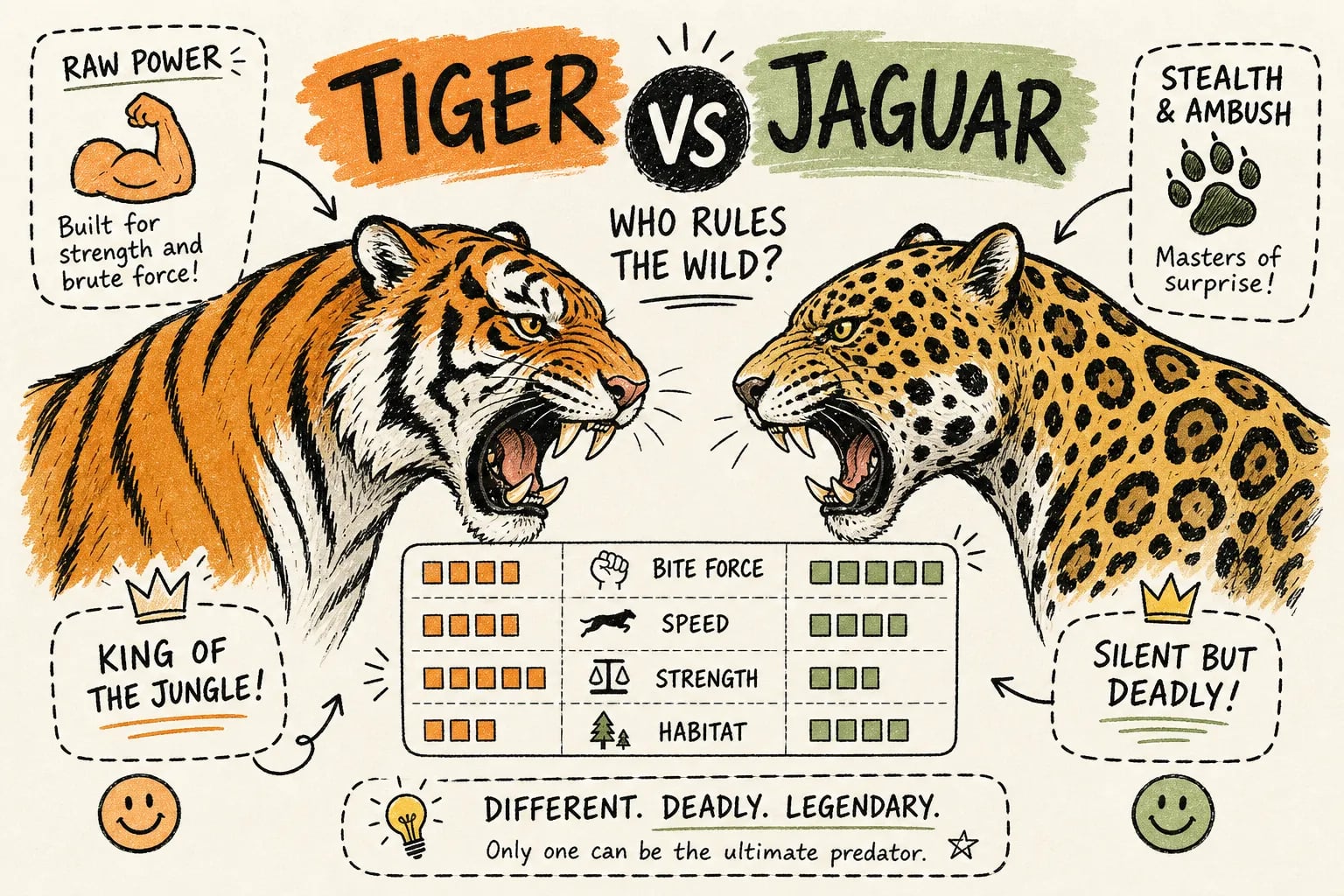
Picture a Bengal tiger moving through the Sundarbans at low tide, its orange and black frame almost vanishing between the mangrove roots and brackish water. Now picture a jaguar crossing the Pantanal at dusk, its spotted coat merging with the rippling light off the floodplain. Both animals are apex predators. Both regulate entire ecosystems. Both are disappearing at a rate that most population data struggle to convey.
Tigers are the largest wild cat species on Earth and the most globally recognized, yet most people’s knowledge stops at the orange coat and black stripes. What they don’t know is that there are six recognized subspecies, each adapted to a radically different environment, each with its own population status and set of pressures. Recent taxonomic work has begun grouping these into two broader clusters (continental and Sunda), but the six-subspecies framework remains standard in conservation reporting. This article walks through all of them, explains what drives their numbers up or down, and then introduces the jaguar as the ecological counterpart in South America. By the end, you’ll know how to tell a Sumatran from an Amur, understand why the numbers look the way they do, and have a clear picture of what conservation actually accomplishes.
What sets tigers apart from every other big cat
A coat built for cover, a body built for power
Tigers are the heaviest wild cat species alive. Males of some Bengal and Amur populations can exceed 400 lbs (180 kg), and that raw mass, combined with extraordinarily powerful forelimbs, allows them to take down prey much larger than themselves, including water buffalo and gaur. No other cat reliably hunts at that scale. The physical advantage is real, but it also means these felids need large prey bases to survive, which ties their wellbeing directly to healthy, undisturbed ecosystems.
The stripe pattern is the most recognizable feature Panthera tigris carries, and no two individuals share the same configuration. Researchers use stripe patterns the way investigators use fingerprints: to identify specific animals in camera-trap images and track their movements across years. Beyond identification, those stripes break up the cat’s silhouette in dappled forest light, making a 400-lb predator genuinely invisible in dense vegetation when it holds still.
Solitary hunters with territorial precision
Tigers are solitary and fiercely territorial. Radio-tracking studies show that a single male’s territory can vary widely, spanning roughly 40 to 60 square miles in areas with adequate prey, and expanding considerably where prey is scarce. Females hold smaller ranges that often overlap with a male’s territory, and both sexes enforce their boundaries through scent marking, vocalizations, and direct confrontation when necessary.
Activity patterns vary by subspecies, region, and degree of human disturbance, though camera-trap analyses consistently show these cats are most active at dawn and dusk, ambushing prey with short explosive bursts rather than sustained chases. This behavioral profile makes them particularly sensitive to habitat fragmentation. A tiger needs large, connected forest blocks to hunt effectively, find mates, and avoid the edges where forest meets farmland and conflict begins.
Six faces of Panthera tigris: how to recognize each subspecies
Northern giants vs. southern island cats
The six recognized subspecies divide roughly into northern and southern groups, and the physical differences are easy to spot once you know what to look for. Amur tigers from the Russian Far East have pale orange coats, fewer stripes, and thick fur built for sub-zero winters. Bengal tigers from the Indian subcontinent wear richer orange with bold, broad black stripes and shorter fur suited to tropical and subtropical forests. A useful rule of thumb runs through the whole group: the farther north and colder the habitat, the larger, paler, and more lightly striped the cat.
Moving south and east, Indochinese tigers are smaller and darker than Bengals, with shorter, narrower stripes across their coats. Sumatran tigers, the smallest living subspecies, have the darkest coats and the densest stripe pattern of the group. That high stripe density is understood to be an adaptation to Sumatra’s thick rainforest understory, where breaking up a silhouette matters more than it does in open woodland. Malayan tigers from Peninsular Malaysia look similar to Indochinese cats but are genetically distinct, a separation confirmed by DNA analysis in 2004 when Panthera tigris jacksoni was formally recognized.
The South China tiger: a subspecies already lost
The South China tiger historically carried a striking reddish-orange coat with very long, narrow stripes, a distinctive look that set it apart from every other living subspecies. Today it is functionally extinct in the wild, with no confirmed sighting recorded in decades. The captive population numbers roughly 200 animals, all descended from a handful of founders, and no coordinated rewilding program has been launched at scale. It stands as the starkest warning in conservation history.
The Malayan tiger, which currently numbers fewer than 150 to 200 individuals, is following a trajectory uncomfortably close to that of the South China tiger. Once a wild population collapses below a functional threshold, recovery requires extraordinary intervention that rarely comes in time.
Where tigers still roam: habitats and shrinking ranges
From Siberian forests to Sumatran rainforests
Tiger habitat today spans an enormous range of ecosystems. Bengal tigers occupy tropical moist broadleaf forests, dry forests, alluvial grasslands, and the unique mangrove system of the Sundarbans on the India-Bangladesh border. Amur tigers live in the temperate evergreen forests of Russia’s Far East, enduring winters that would kill a Sumatran within days. Sumatran tigers are confined entirely to one island. Despite these differences, all subspecies share three non-negotiables: cover, prey, and water.
At their historical peak, these cats ranged across much of Asia, from Turkey through Iran and into eastern Russia and Indonesia. Today, the species occupies roughly 5% of that former range, according to IUCN assessments. That contraction has accelerated alongside agricultural expansion, road construction, and industrial development across the continent.
Why fragmented habitat turns a large predator into a vulnerable one
A tiger confined to a forest patch surrounded by farms and roads faces compounding problems. It cannot find enough prey. It cannot safely reach potential mates. It is forced into closer contact with livestock and people, triggering conflict that almost always ends with the animal killed in retaliation or removed from the wild entirely.
Roads through forests deserve special attention as a threat. They give poachers easier access to previously remote territory and create barriers that prevent gene flow between isolated subpopulations. Studies have also documented vehicle strikes as a source of mortality in regions where roads cut through core habitat, a threat whose severity varies considerably by area. Conservation organizations now treat wildlife corridors as a primary recovery strategy precisely because fragmentation can doom a population even when poaching is controlled. Connecting strips of protected habitat between forest blocks allows individuals to move, breed, and maintain genetic diversity across a wider landscape.
The hard numbers: tiger population estimates by subspecies
The most widely cited current global estimate places total wild tiger numbers at approximately 5,574 individuals, though the IUCN Red List range runs from 3,726 to 5,578, not counting cubs. Bengal tigers account for the largest share, 3,200 to 3,500 individuals, largely because of India’s Project Tiger program, which now covers 58 reserves across 18 states. India’s national count rose from roughly 1,706 individuals in 2010 to 3,682 in 2022, a result that demonstrates what well-funded, science-driven conservation can accomplish when it is sustained over time.
The picture elsewhere is more sobering. Amur tigers number around 500 to 600, mostly concentrated in Russia’s Sikhote-Alin region. Sumatran tigers sit at 370 to 600, with the spread reflecting differences between IUCN and national survey methodologies. Indochinese tigers number 150 to 300 across fragmented mainland Southeast Asia. The Malayan subspecies has fewer than 150 to 200 individuals remaining. Three overlapping threats explain every one of those figures: poaching, habitat loss, and human-wildlife conflict. All three have remained severe or worsened in recent years, even as conservation programs have achieved real gains in specific areas.
Meet the jaguar: South America’s ecological twin to the tiger
Same role, different continent
On the other side of the world, a different big cat fills nearly the same ecological niche. The jaguar is the largest cat in the Americas and the third largest on Earth. Like the tiger, it is a solitary apex predator that controls prey populations, shapes ecosystem structure, and requires large connected territories to survive. Both cats sit at the top of their respective food webs, and both ecosystems show measurable signs of instability when those cats disappear, prey populations surge, vegetation is overgrazed, and the cascade of effects reaches far down the food chain.
The jaguar’s stronghold is the Pantanal, the world’s largest tropical wetland, located mostly in Brazil. The Pantanal hosts the densest jaguar population on Earth, supported by the floodplain’s extraordinary productivity and prey abundance. Jaguars also range across the Amazon basin, the Cerrado, and Atlantic Forest fragments. Brazil holds the largest share of jaguar habitat and population on Earth, making it one of the most consequential countries for the species’ long-term survival, a responsibility that carries the same weight as India’s role in tiger recovery.
Where to go deeper on Brazilian big cats and biomes
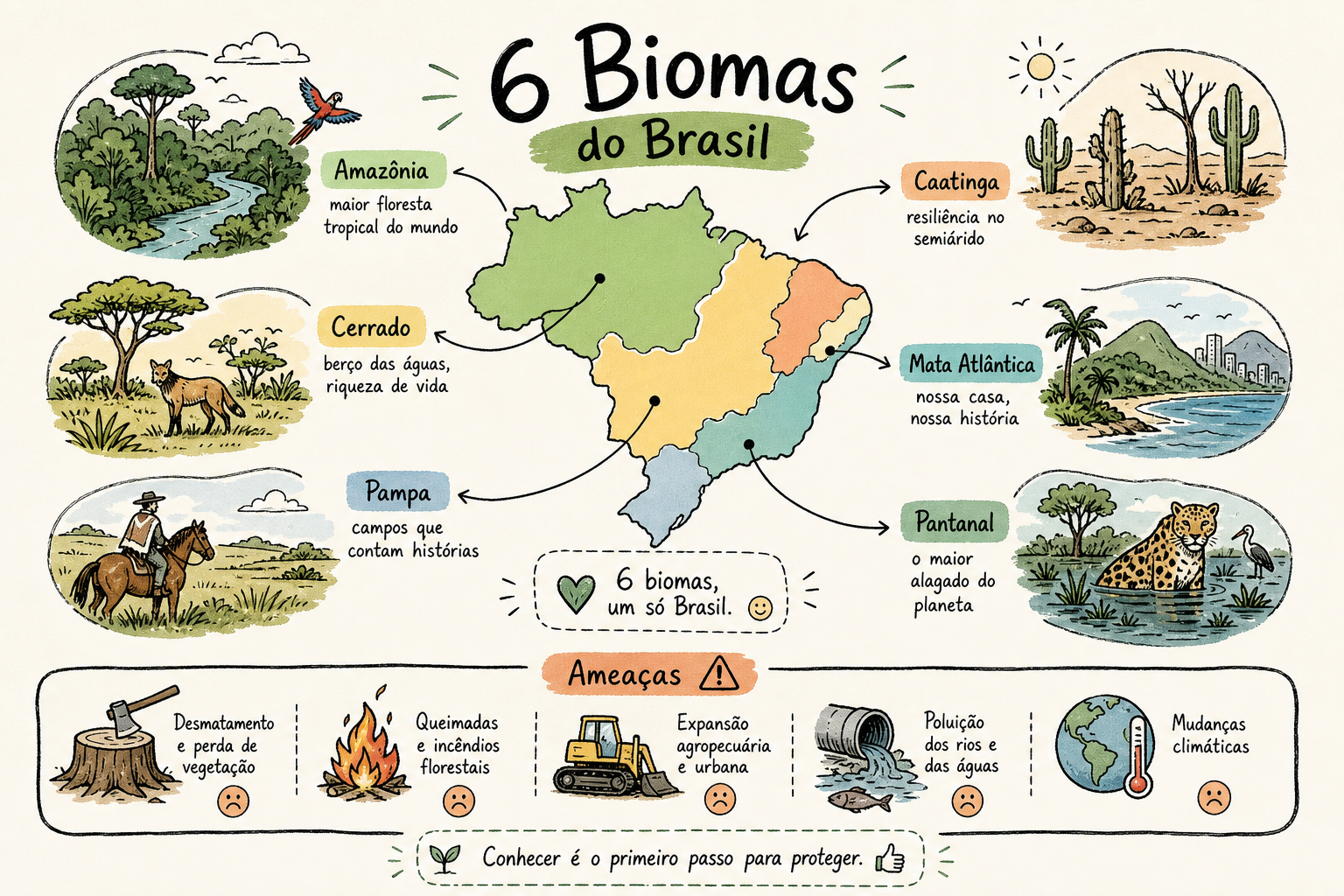
Brazil’s five major biomes, the Amazon, Pantanal, Cerrado, Atlantic Forest, and Caatinga, each present different conservation challenges for jaguars. The Amazon presents deforestation driven by agricultural expansion. The Cerrado faces one of the highest rates of habitat conversion of any tropical biome. Understanding how each ecosystem shapes jaguar behavior, prey dynamics, and conflict patterns requires more than a paragraph.
Bio Informa is a dedicated educational resource covering Brazilian fauna, biomes, and the ecological roles of species like the jaguar. The content is designed to be accessible to readers at different levels, whether you’re encountering these topics for the first time or looking for structured references as an environmental educator. If the tiger’s story opened a door, the jaguar’s story is where Brazilian conservation gets specific.
Concrete steps that actually move the needle
What major programs have documented
The conservation numbers are not all discouraging. Panthera’s Tigers Forever program reports that six of seven project sites show stable or increasing populations, with numbers in Thailand’s Western Forest Complex nearly doubling over the past decade. Nepal’s count rose from 121 individuals in 2009 to 355 in 2022. WWF reports a 74% increase in global wild tiger numbers since the TX2 initiative launched. The IUCN’s Integrated Tiger Habitat Conservation Programme documented a 40% increase in tiger numbers within project sites between 2015 and 2022, alongside 10,500 hectares of restored habitat and 675,000 people reached through conservation awareness programs.
These results share a recognizable pattern. Targeted funding, anti-poaching ranger networks, and community livelihood programs that give local people an economic stake in keeping these cats alive all appear consistently across the highest-performing sites. None of it is accidental, and none of it is cheap. The programs that fail tend to lack at least one of those components.
What you can do today
Financial support goes directly to the field programs producing those results. WWF, Panthera, and WCS all run tiger-specific programs where contributions fund rangers, corridor protection, and community development initiatives that reduce human-wildlife conflict at the source. Beyond donations, reducing demand for illegal wildlife products, reporting suspicious online wildlife trade activity, and choosing brands with verified sustainable sourcing all reduce pressure on tiger habitats.
For readers in Brazil, supporting jaguar conservation through organizations working in the Pantanal and Amazon produces the same ecosystem benefits closer to home. The two cats are separated by two continents, but the conservation logic is identical: protect the apex predator, and you protect the entire web of species below it.
A story worth staying with
Tigers and jaguars are separated by two continents and two entirely different ecosystems, but they share a common reality. Both are apex predators whose loss substantially alters ecosystem structure and function, and both face the same broad threats playing out in different landscapes. The tiger’s story, told through its six subspecies, their habitats, their numbers, and the programs working to stabilize them, is ultimately a story about what happens when human activity shrinks the space a large predator needs to survive. It is also a story about what targeted conservation can reverse when the resources and commitment are there.
For readers most drawn to the jaguar’s side of this comparison, that story runs deep in Brazil’s Pantanal, Amazon, and Cerrado. Bio Informa approaches it with the same clarity and specificity that any apex predator’s ecology deserves, grounded content for curious beginners, trail hikers, educators, and naturalists who want more than surface-level coverage.





Deixe uma resposta